Analog Horror Text to Speech: How to Create a Creepy AI Voice (+ 12 Prompts)
Create an analog horror voice with AI text to speech. Hear 12 creepy examples and copy prompts for broadcasts, witnesses, archives, and more.
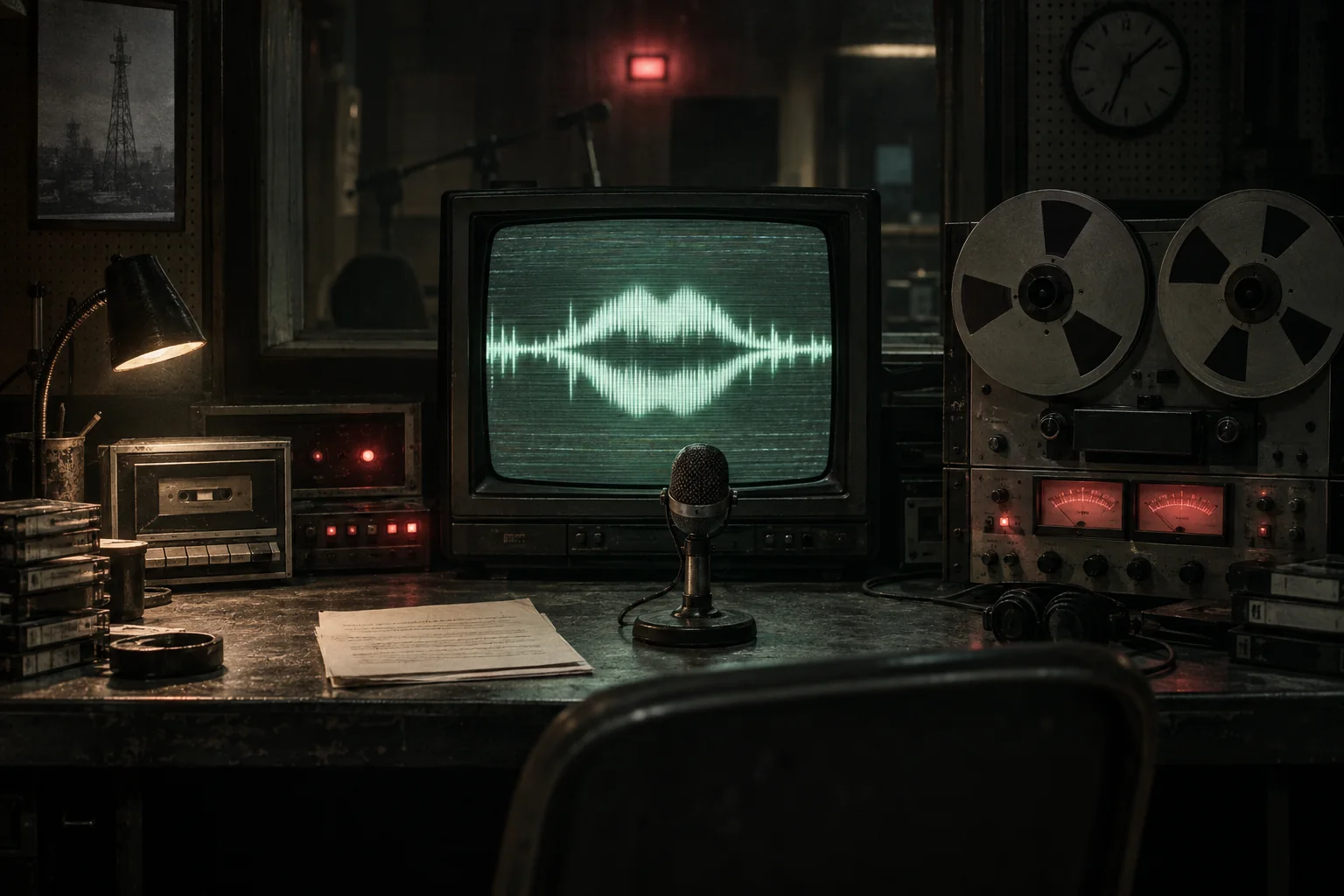
The most convincing analog horror text to speech rarely begins with a monster voice. It begins with someone familiar: a civil-defense announcer, a teacher, a radio host, or a tired telephone operator. The voice stays almost normal while the words reveal that something is terribly wrong.
Below are 12 copyable prompts for voices across different ages and gender presentations. Every audio example was generated with the same wavespeed-ai/qwen3-tts/voice-design model used by AI Dubbing’s text-to-speech tool. The recordings are the raw model output: no music, static, distortion, or tape effects were added.
Want to make your own version? Open the text-to-speech generator, paste a sample line, copy one of the voice descriptions below, select English, and generate a take.
In this guide
- What makes analog horror text to speech unsettling?
- 12 analog horror voice prompts with audio examples
- How to create a creepy AI voice from text
- A reusable creepy voice prompt formula
- How to add an old broadcast or VHS sound
- Common analog horror TTS mistakes
- Frequently asked questions
- Create your analog horror voice
What makes analog horror text to speech unsettling?
Analog horror voice design works through contrast. The speaker sounds recognizable and controlled, but the message violates what the listener expects from that voice. A cheerful classroom narrator explaining a dangerous rule can feel stranger than a voice that simply growls.
Four ingredients do most of the work:
- A specific speaker: Define an approximate age, gender presentation, vocal range, and social role.
- A believable recording context: Emergency bulletin, training tape, medical log, local radio show, school film, or recovered archive.
- Restrained emotion: Ask for fear being suppressed, forced reassurance, fatigue, or unnatural cheer rather than constant panic.
- Directed pacing: Use measured pauses, clipped phrases, a hushed ending, or a change of pace on the final clause.
The optional lo-fi treatment comes afterward. Generate a clear performance first so you can decide how much intelligibility to trade for atmosphere.
12 analog horror voice prompts with audio examples
These are voice-description prompts, not scripts for impersonating real people. Each one creates a fictional speaker with a distinct age, timbre, role, and emotional direction. Because voice design is generative, a second take may differ even when the prompt is unchanged.
1. Elderly male emergency-broadcast announcer
Use this for a civil-defense transmission or emergency alert that becomes more alarming because the speaker never loses control.
Voice prompt
A seventy-year-old man delivering a civil defense broadcast in a deep, weathered baritone with a neutral American accent. Stern, controlled, and unnervingly calm, with slow measured pacing, long pauses, precise diction, and restrained urgency. Clean dry studio speech with no music, static, or sound effects.Sample script: “This is not a test. Remain indoors and keep every window covered until the signal ends.”
Why it works: “Restrained urgency” keeps the read authoritative instead of turning it into an action trailer.
2. Middle-aged female public-information narrator
This voice suits a faded government film, workplace safety reel, or domestic warning recorded decades ago.
Voice prompt
A forty-five-year-old woman narrating a 1970s public-information film in a low alto with a lightly clipped British accent. Polite and composed, but with a faint tremor she is trying to conceal. Use a slow formal cadence, careful enunciation, and unsettling pauses. Clean dry studio speech with no music, static, or sound effects.Sample script: “If you hear your name from the hallway, do not answer. The building has been empty since Tuesday.”
Why it works: The precise delivery makes the impossible instruction sound like an established safety procedure.
3. Young androgynous archive technician
Choose this for a recovered research log, evidence tape, or late-night facility recording.
Voice prompt
A twenty-four-year-old androgynous laboratory technician with a light, narrow voice and no strong regional accent. Sleep-deprived and detached, speaking just above a whisper in clipped phrases, with uneasy hesitation and occasional audible breaths. Clean dry studio speech with no music, static, or sound effects.Sample script: “Archive entry forty-seven. The speaker on this tape was never assigned to our facility.”
Why it works: Fatigue and clipped phrasing suggest the speaker has repeated the procedure too many times.
4. Elderly female false-reassurance voice
This prompt starts with a warm grandmotherly performance and lets the writing introduce the threat.
Voice prompt
An eighty-year-old woman with a soft, warm, grandmotherly voice that is slightly breathy and fragile. Gently reassuring yet subtly wrong, with a slow intimate pace, a faint smile, and careful pauses before the disturbing words. Clean dry studio speech with no music, static, or sound effects.Sample script: “Come inside, dear. Your parents are waiting downstairs, exactly where we left them.”
Why it works: Familiar warmth and an affectionate address make the last phrase feel more intrusive.
5. Frightened teenage male witness
Use this style for a handheld-camera confession, voicemail, or witness statement recorded moments after an event.
Voice prompt
A seventeen-year-old boy with a thin youthful tenor and a neutral American accent. A frightened witness trying to stay quiet, with quick shallow breaths, uneven pacing, words catching in his throat, and a barely controlled whisper. Clean dry studio speech with no music, static, or sound effects.Sample script: “I saw the tower blink three times, and then everyone in the field turned toward me.”
Why it works: The direction asks for someone hiding fear rather than performing a continuous scream.
6. Young female educational-film narrator
This deliberately cheerful child voice fits a corrupted school tape or an instructional film built around an impossible rule.
Voice prompt
A ten-year-old girl with a clear, bright classroom-reading voice. Cheerful, obedient, and unnaturally matter-of-fact, using a gentle sing-song rhythm, crisp diction, and absolutely no fear in the delivery. Clean dry studio speech with no music, static, or sound effects.Sample script: “Good morning, class. Today we will learn why the sun must never see your face.”
Why it works: A bright, obedient delivery creates sharper contrast with the warning in the script.
7. Middle-aged male midnight-radio host
Pick this voice for a local radio interruption, call-in show, or station that appears to be broadcasting from the wrong time.
Voice prompt
A fifty-two-year-old man hosting a small-town late-night radio program, with a smoky low voice and a neutral American accent. Warm and familiar but visibly tired, speaking at a slow conversational pace with quiet confidence and a trace of unease. Clean dry studio speech with no music, static, or sound effects.Sample script: “You are listening to Warden County Radio. The time is midnight, although every clock says noon.”
Why it works: A conversational host voice makes the temporal contradiction sound like ordinary local news.
8. Young female switchboard operator
This voice can carry a telephone recording, numbers-station scene, or automated help line that has become personal.
Voice prompt
A twenty-six-year-old woman with an airy contralto and a formal old-fashioned switchboard manner. Exhausted but forcing professional composure, speaking softly with restrained panic, precise diction, and a hushed final phrase. Clean dry studio speech with no music, static, or sound effects.Sample script: “Operator nine speaking. Please stop calling this number; the voice on the line is using mine.”
Why it works: The prompt directs an emotional change inside one sentence instead of asking for a single static mood.
9. Nonbinary adult museum archivist
Use this measured, gender-ambiguous voice for an orientation recording, museum exhibit, archive intake, or recovered file.
Voice prompt
A thirty-four-year-old nonbinary museum archivist with an androgynous medium-pitched voice and clear neutral pronunciation. Emotionally detached, clinical, and precise, with even pacing and a slight pause before the final clause. Clean dry studio speech with no music, static, or sound effects.Sample script: “Recovered file begins here. Any resemblance to your childhood is an intended part of the procedure.”
Why it works: Clinical language and even pacing imply the unsettling effect is deliberate and repeatable.
10. Older male rural preacher
This prompt fits a sermon recording, community-access broadcast, or meeting tape that slips from certainty into awe.
Voice prompt
A sixty-eight-year-old man with a resonant bass voice and a subtle Southern American accent, delivering a solemn rural church sermon. Measured and authoritative at first, then quietly awed and deeply afraid, with long deliberate pauses. Clean dry studio speech with no music, static, or sound effects.Sample script: “The congregation may open its eyes now. Something else has already opened theirs.”
Why it works: The emotional arc lets authority weaken gradually instead of disappearing all at once.
11. Adult female medical-log narrator
Use this voice for a laboratory report or clinical observation whose final detail breaks the speaker’s composure.
Voice prompt
A thirty-eight-year-old woman with a confident professional mezzo voice, recording a clinical medical log. Crisp and controlled at first, then suppressing panic as the sentence continues, with the final words slightly faster and quieter. Clean dry studio speech with no music, static, or sound effects.Sample script: “Patient zero has no pulse, but the microphone continues to record breathing from inside the room.”
Why it works: The technical opening gives the listener a stable baseline before the voice begins to fracture.
12. Adult male children’s-show host
Use this high-energy voice for a children’s program, game-show segment, or cheerful test that punishes the wrong response.
Voice prompt
A thirty-two-year-old man with a bright high-energy voice like a cheerful children's television host. Broadly smiling, rhythmic, and inviting, but shifting into eerie flat certainty on the final phrase without becoming loud. Clean dry studio speech with no music, static, or sound effects.Sample script: “Smile for the camera, friends. If you stop smiling, the program will know you are awake.”
Why it works: The hard turn from exaggerated warmth to flat certainty makes the final threat land without shouting.
How to create a creepy AI voice from text
You can turn any of the prompts above into speech in a few steps:
- Open Text to Speech with Emotions.
- Paste the line you want the character to say into Text to speak.
- Paste the corresponding prompt into Describe the voice you want.
- Select the script language. Use English for the examples in this guide.
- Generate the voice, listen to the entire take, and download it when the delivery fits the scene.
If the first result misses, change one instruction at a time. “Slower and more formal” is easier for the model to act on than adding five new adjectives. You can also rewrite punctuation: a period creates a firmer break, while a comma usually keeps the thought moving.
A reusable creepy voice prompt formula
Build new prompts in this order:
A [specific age] [gender presentation] [role] with a [pitch and texture] voice and [accent]. [Emotional state being shown or suppressed]. Use [pace], [diction], [pause pattern], and [change in delivery]. Clean dry studio speech with no music, static, or sound effects.For example, “scary old man” leaves nearly every performance decision open. “A seventy-year-old emergency announcer with a weathered baritone, restrained urgency, precise diction, and long pauses” gives the model a character, context, texture, emotion, and rhythm.
Age and gender descriptors guide the generated performance; they do not select a fixed actor. If a take does not fit the character, revise the description or generate another variation.
How to add an old broadcast or VHS sound
The voice examples above are intentionally clean. AI Dubbing’s text-to-speech tool creates the performance; it does not add tape hiss, radio filtering, glitches, or VHS damage. Keeping those steps separate preserves intelligibility and gives you more control in the final edit.
After downloading the voice, try this restrained processing order in your audio or video editor:
- Band-limit the voice: Roll off some low bass and high treble to suggest a small speaker or old recording.
- Add light compression: Reduce the dynamic range so the announcement feels broadcast-ready.
- Use distortion sparingly: A little saturation can add age; heavy distortion hides the words.
- Introduce slow instability: Subtle pitch drift or wow and flutter can imply damaged tape.
- Place noise underneath: Room tone, hum, or tape hiss should support the voice rather than cover it.
- Save glitches for meaningful moments: A dropout on a name or warning is more effective than constant random damage.
Always check the finished scene on headphones and phone speakers. If a listener cannot understand the key rule, name, or reveal, reduce the effect before increasing the volume.
Common analog horror TTS mistakes
Making every voice deep and demonic
A deep voice can work, but twelve versions of the same growl flatten your cast. Contrast an elderly announcer with a frightened teenager, a precise archivist, or an overly cheerful host.
Writing emotion without behavior
“Scared” is vague. Describe what fear does to the delivery: quicker breaths, words catching, a final phrase spoken more quietly, or professional composure beginning to fail.
Asking the TTS model to create the entire soundscape
Voice generation and tape treatment are different jobs. Generate clear dialogue first; add the radio, room, and glitch effects during editing.
Copying a recognizable person or character
Design an original fictional role instead. Age, vocal texture, pacing, and emotional direction give you plenty of control without asking for a celebrity or protected character imitation.
Frequently asked questions
What text-to-speech voice is used in analog horror?
There is no single required analog horror voice. Creators commonly use calm emergency announcers, educational-film narrators, witnesses, operators, archivists, and other ordinary voices made unsettling by the script, delivery, and optional tape-style processing.
How do I make an AI voice sound creepy?
Describe the speaker’s age, vocal range, role, emotional restraint, pace, and performance arc. A familiar voice that stays controlled while saying something impossible is often more unsettling than a theatrical monster voice.
Does AI Dubbing add VHS static or radio distortion?
No. The text-to-speech tool generates a clean voice recording. Add band-limiting, compression, light distortion, wow and flutter, room tone, or tape hiss later in an audio or video editor if the scene needs an aged broadcast sound.
Can I create analog horror voices of different ages and genders?
Yes. Describe the age range, gender presentation, pitch, texture, accent, role, emotion, and pace you want. Voice design is generative, so preview the result and regenerate or revise the description when a take does not fit the character.
Create your analog horror voice
Start with one sentence, one speaker, and one emotional turn. Use one of the prompts above as a base, adjust the character details to fit your story, and create your analog horror text-to-speech voice. Once the performance works without effects, export it and build the damaged broadcast around it.